Road bike tyre pressure is one of the most overlooked and misunderstood parts of road cycling.
Many riders spend hours comparing bikes, wheels, and components, then pump their tyres to a random number they’ve used for years and head out the door. Often, that number is too high. Sometimes it’s wildly too high.
The truth is simple:
Correct tyre pressure affects comfort, speed, handling, grip, and fatigue more than almost any other adjustment you can make.
This guide explains:
- Why tyre pressure matters
- Why “harder is faster” is outdated
- How to choose the right pressure for your riding
- Practical starting points you can actually use
No myths. No guesswork. Just real-world advice.
Why ROAD BIKE Tyre Pressure Matters So Much
Tyres are your only contact with the road.
Their pressure determines:
- How much vibration reaches your body
- How well the tyre grips in corners
- The stability the bike feels at speed
- How fatigued you feel after long rides
Too much pressure makes the bike harsh, skittish, and tiring.
Too little pressure makes it vague, slow, and potentially unsafe.
The goal isn’t maximum firmness — it’s balance.
The Old Myth: “Harder Tyres Are Faster”
For years, road cyclists were told to inflate tyres to:
- 100–120 psi
- Or “as hard as possible without flatting”
This advice came from a time when:
- Tyres were narrow (19–23mm)
- Roads were smoother (or at least assumed to be)
- Comfort wasn’t considered performance
Modern research and real-world testing has shown this clearly:
Over-inflated tyres are slower on real roads.
Why?
Because a tyre that’s too hard:
- Skips over rough surfaces
- Loses traction
- Transmits vibration into your body (which costs energy)
Lower, appropriate road bike tyre pressure allows the tyre to deform slightly, maintaining contact with the road and rolling more efficiently.
What Determines the Right ROAD BIKE Tyre Pressure?
There is no single “correct” pressure, but there is a correct range.
The right pressure depends on five main factors:
1. Tyre Width (The Biggest Factor)
Wider tyres need less pressure, not more.
General rule:
- 23mm → higher pressure
- 25mm → moderate pressure
- 28–32mm → lower pressure
This is why modern road bikes have moved toward 28mm tyres — they’re faster and more comfortable on real roads.
2. Rider Weight (Including Bike)
Heavier riders need more pressure. Lighter riders need less.
Importantly:
- Don’t copy someone else’s pressure
- Don’t use “pro” pressures unless you weigh the same
A 60kg rider and a 90kg rider should not be running the same numbers — even on the same bike.
3. Road Surface
Smooth tarmac = slightly higher pressure
Rough roads = lower pressure
Northern France, chipseal, broken asphalt, and winter roads all reward lower pressure.
If the road is imperfect (most are), softer tyres are faster and more controlled.
4. Tyre Construction & Tubeless vs Tubes
- Tubeless tyres can run lower pressures safely
- Latex tubes allow slightly lower pressure than butyl
- Stiffer tyres often feel better at slightly lower pressure
Tubeless setups also reduce pinch-flat risk, allowing more experimentation.
5. Front vs Rear Tyre
Your rear tyre carries more weight.
As a rule:
- Rear tyre: +5–10 psi compared to front
This improves balance and grip, especially in corners.
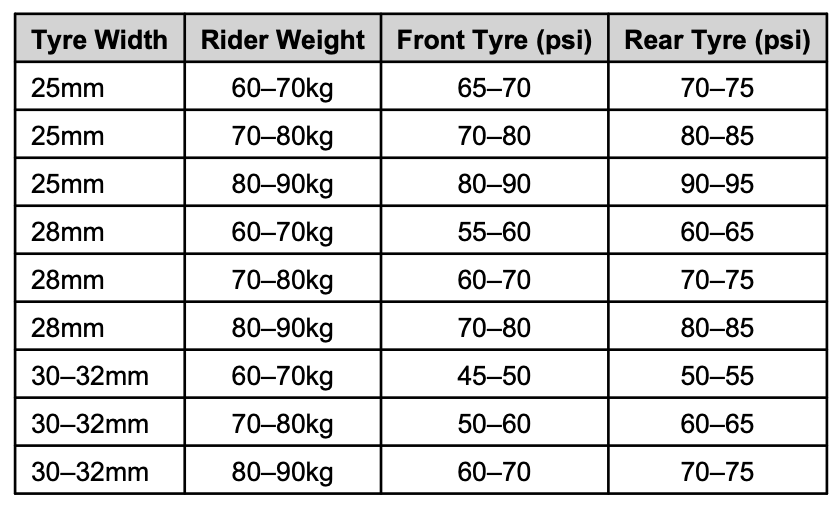
Real-World Starting Pressures (Road Bikes)
These are practical starting points, not absolutes.
25mm Tyres
- 60–70kg rider: 65–75 psi
- 70–80kg rider: 70–85 psi
- 80–90kg rider: 80–95 psi
28mm Tyres
- 60–70kg rider: 55–65 psi
- 70–80kg rider: 60–75 psi
- 80–90kg rider: 70–85 psi
30–32mm Tyres
- 60–70kg rider: 45–55 psi
- 70–80kg rider: 50–65 psi
- 80–90kg rider: 60–75 psi
Front tyre: Aim 5–10 psi lower than rear.
These numbers will feel low if you’ve been riding over-inflated tyres. Give them time.
How to Tell If Your Pressure Is Too High
Common signs:
- The bike feels harsh and nervous
- You feel buzz through hands and feet
- The bike skips over rough surfaces
- Cornering feels less confident
- You feel unusually fatigued after rides
Many riders think this is just “road feel.” Often, it’s just too much air.
How to Tell If Your Pressure Is Too Low
Signs of under-inflation:
- Squirmy feeling in corners
- Excessive tyre deformation
- Frequent rim strikes (with tubes)
- Sluggish acceleration
If the bike feels vague rather than planted, add a little pressure.
Tubeless Tyre Pressure: Why It Changes Everything
Tubeless road setups allow:
- Lower pressures
- Better grip
- Reduced rolling resistance on rough roads
- Fewer pinch flats
Many riders switching to tubeless discover their ideal pressure is 10–15 psi lower than with tubes.
This is one of the biggest comfort upgrades available in road cycling today.
Does ROAD BIKE Tyre Pressure Affect Speed?
Yes, but not in the way people think.
On a perfectly smooth velodrome, higher pressure is faster.
On real roads, optimal pressure is faster.
Lower road bike tyre pressure:
- Reduces vibration losses
- Improves traction
- Allows smoother power delivery
For long rides, correct pressure often saves more energy than lightweight components.
Seasonal Adjustments: Don’t Ignore This
Tyre pressure changes with temperature.
- Cold weather = pressure drops
- Warm weather = pressure increases
If you set tyres indoors in winter, expect them to lose a few psi once outside. Check pressure before riding, not the night before.
Common Tyre Pressure Mistakes
– Pumping to the maximum listed on the tyre
– Copying a friend’s pressure
– Running race pressures on rough roads
– Ignoring tyre width changes
– Never experimenting
The number on the sidewall is a maximum, not a recommendation.
A Simple Way to Dial In Your Ideal Pressure
- Start slightly lower than you think
- Ride a familiar loop
- Pay attention to comfort and control
- Add or subtract 2–3 psi next ride
- Repeat
Within a few rides, you’ll find a sweet spot.
When you do, the bike will feel calmer, quieter, and easier to ride.
Final Thoughts: Small Change, Big Difference
If you only change one thing on your bike this week, make it tyre pressure.
It costs nothing.
It takes five minutes.
And it can completely change how your bike feels.
The right pressure doesn’t make your bike feel slower. It makes it feel right.
And when a bike feels right, you ride longer, smoother, and with more confidence.
That’s real performance.
FAQs
Is lower tyre pressure always better?
No. Too low causes instability. The goal is optimal, not minimal.
Do pros run lower pressures now?
Yes, especially with wider tyres and tubeless setups.
Should I check pressure every ride?
Ideally, yes. Tyres lose air naturally.
Is tyre pressure more important than tyre brand?
Often, yes. A well-set average tyre beats a premium tyre at the wrong pressure.