
If you ride a bike with gears, brakes, or pedals, there’s a very good chance Shimano had something to do with it.
Unlike bike brands that shout through paint jobs and pro wins, Shimano’s influence is quieter — but far deeper. Shimano doesn’t just make components; it has defined how cycling works for decades. From entry-level commuters to Tour de France race bikes, Shimano sits at the mechanical heart of the sport.
This is the story of Shimano: where it came from, what it does for cycling, and why it’s one of the most important brands the sport has ever known.
Shimano at a Glance
- Founded: 1921
- Country: Japan
- Founder: Shozaburo Shimano
- Core focus: Drivetrains, brakes, pedals, wheels, footwear
- Known for: Reliability, innovation, accessibility, standard-setting
Shimano isn’t a bike brand. It’s something more fundamental: the company that makes bikes function.
The Origins: From One Freewheel to a Global Standard
Shimano began in 1921 in Sakai, Japan, when Shozaburo Shimano started producing bicycle freewheels in a small ironworks. At the time, Japan relied heavily on imported cycling components, and Shimano’s early mission was simple:
Make high-quality bicycle parts domestically — and make them better.
That mindset never left.
From that first freewheel, Shimano gradually expanded into chains, derailleurs, brakes, pedals, hubs, and eventually complete drivetrain systems. Rather than chasing flashy branding, Shimano focused on precision manufacturing, consistency, and scale.
By the late 20th century, Shimano wasn’t just a supplier. It was the default choice.
What Shimano Actually Does for Cycling
Shimano’s role in cycling goes far beyond making parts. It has shaped how bikes are built, sold, maintained, and ridden.
1. Shimano Makes Cycling Accessible
One of Shimano’s biggest contributions is something riders often overlook: accessibility.
Shimano produces component groups at nearly every price level:
- Entry-level (for beginners and commuters)
- Mid-range (enthusiast and club riders)
- High-end (professional racing)
Crucially, Shimano doesn’t abandon lower tiers when it innovates. Features pioneered at the top. The better shifting, braking, and ergonomics filter down over time. That’s why today’s entry-level bikes work far better than high-end bikes from 20 years ago.
This trickle-down approach has arguably done more to grow cycling than any single race win.
2. Shimano Defined the “Groupset” Concept
Before Shimano, bike components were often mixed and matched between brands. Shimano changed that by introducing the idea of a fully integrated groupset, where shifters, derailleurs, brakes, chain, and cassette are designed to work together.
This matters because:
- Shifting becomes smoother and more predictable
- Setup and maintenance are easier
- Performance is consistent across bikes and brands
Today, the term groupset is universal, and Shimano is the reason.
3. Shimano Standardised How Bikes Feel
If you’ve ever jumped on a friend’s bike and instantly understood how to shift or brake, that’s Shimano’s influence.
Shimano’s ergonomics, especially in road bike shifters became the reference point for the entire industry. Lever feel, shift logic, brake modulation: these things feel “normal” because Shimano made them normal.
Even competitors often design in response to Shimano.
Shimano Road Bike Groupsets Explained
Shimano’s road lineup is one of its greatest achievements. Each tier serves a clear purpose, and there’s no “bad” option — only different use cases.
Shimano Claris & Sora
Who they’re for: Beginners, commuters, budget road bikes
Why they matter: Durable, affordable, and reliable
These groupsets introduce riders to drop-bar cycling without intimidation. They’re not flashy, but they work, year after year.
Shimano Tiagra
Who it’s for: Entry-level enthusiasts
Why it matters: The gateway to “serious” road riding
Tiagra offers smoother shifting and better braking, often appearing on endurance bikes and winter trainers.
Shimano 105
Who it’s for: The majority of road cyclists
Why it matters: Possibly the best value groupset ever made
Shimano 105 is famous for good reason. It offers near-Ultegra performance at a significantly lower price, and in recent generations, it gained electronic Di2 shifting, making high-tech cycling more accessible than ever.
Many riders could happily ride 105 for life.
Shimano Ultegra
Who it’s for: Performance-focused enthusiasts
Why it matters: Lighter, faster, more refined
Ultegra is the sweet spot for riders who want race-ready performance without the extreme cost of flagship gear. It’s common on high-end endurance and race bikes.
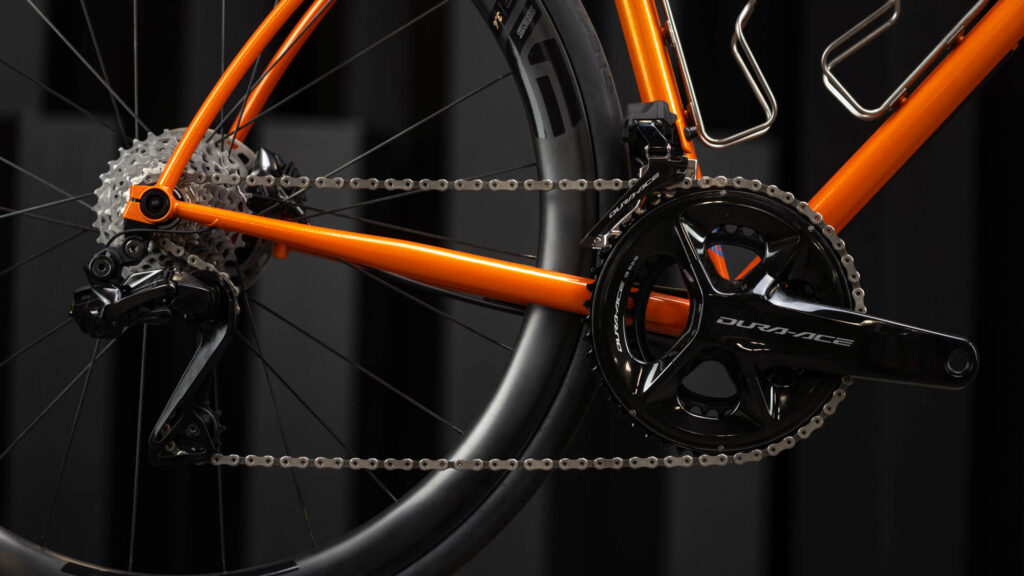
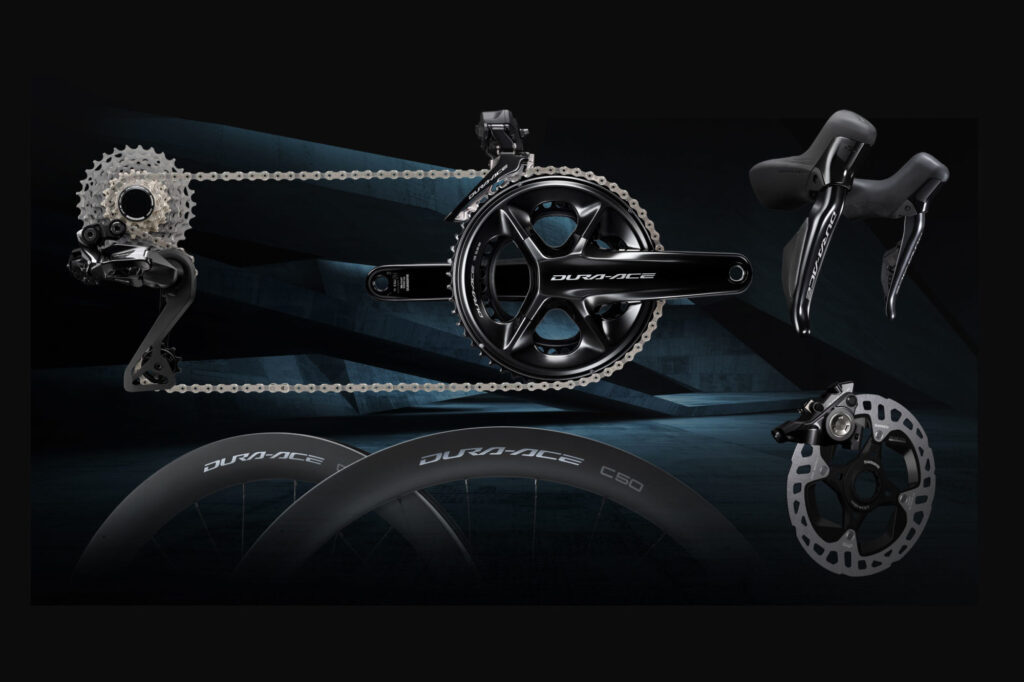
Shimano Dura-Ace
Who it’s for: Professionals and uncompromising enthusiasts
Why it matters: Absolute precision and weight savings
Dura-Ace is Shimano at its most obsessive. Every gram matters, every shift is perfect, and durability remains exceptional, even under pro-level abuse.
Shimano Di2: Electronic Shifting Goes Mainstream
When Shimano introduced Di2 electronic shifting, it changed cycling permanently.
Early scepticism gave way to widespread adoption once riders experienced:
- Perfect shifts under load
- No cable stretch or adjustment
- Consistent performance in all weather
- Long-term reliability
What truly cemented Shimano’s dominance wasn’t just Di2 itself. It was the decision to bring electronic shifting down to 105 level, not keep it locked behind premium pricing.
That move reshaped expectations across the industry.
Braking: Shimano and the Disc Revolution
Shimano also played a huge role in normalising disc brakes on road bikes.
Early road disc systems were controversial, but Shimano’s hydraulic designs proved:
- Powerful
- Predictable
- Easy to modulate
- Extremely reliable
Today, disc brakes are the default, especially on endurance and all-road bikes, and Shimano’s systems are still considered among the most dependable.
Beyond Road: Shimano’s Wider Impact
Shimano’s influence isn’t limited to road cycling.
Mountain Biking
Shimano helped shape modern MTB with:
- Durable drivetrains
- Powerful hydraulic brakes
- Clear product tiers
From trail riders to World Cup racers, Shimano remains deeply embedded in off-road cycling.
Gravel & Adventure
As gravel riding exploded, Shimano adapted quickly:
- Wide-range gearing
- Clutch derailleurs
- Gravel-specific groupsets
Shimano’s approach here mirrors its road philosophy: make new riding styles accessible, not niche.
Commuting & Urban Cycling
Millions of everyday bikes use Shimano components:
- Internally geared hubs
- Durable drivetrains
- Low-maintenance solutions
This may be Shimano’s least glamorous contribution, and its most impactful.
Shimano vs SRAM vs Campagnolo (Briefly)
Every cycling conversation eventually ends up here.
- Shimano: Refined, reliable, intuitive, widely available
- SRAM: Bold, innovative, wireless-first, minimalist
- Campagnolo: Traditional, beautiful, niche, Italian heritage
Shimano’s strength is consistency. It rarely takes wild risks — but when it commits, it executes at scale.
Why Shimano Is So Trusted
Ask mechanics, shop owners, and long-time riders why they trust Shimano, and the answers are usually the same:
- Parts last
- Parts are available everywhere
- Systems work as intended
- Maintenance is predictable
- Failures are rare
In cycling, reliability isn’t exciting, but it’s everything.
Shimano’s Quiet Philosophy
Shimano doesn’t rely on loud branding or hype. Its approach has always been:
- Engineer first
- Test relentlessly
- Improve incrementally
- Make it accessible
That philosophy has shaped how bikes are built, sold, and ridden worldwide.
Final Thoughts: Shimano’s Place in Cycling
Shimano may not be the brand riders dream about first, but it’s the brand that makes those dreams possible.
It’s the reason:
- Entry-level bikes feel good
- High-end bikes work flawlessly
- Electronic shifting is normal
- Cycling keeps growing
Without Shimano, modern cycling wouldn’t look or feel the way it does.
And that’s perhaps its greatest achievement: Shimano made cycling better, quietly, for everyone.